

The global Application-to-Person (A2P) SMS market, valued at approximately US$71.2 billion in 2024, is forecast to expand steadily through to 2035. This growth is underpinned by the enduring reliability of SMS as the world’s most universal communication channel, particularly for enterprise notifications, authentication, government messaging, healthcare alerts, and customer service. Yet, while message volumes continue to rise, the role of SMS itself is undergoing a fundamental change.
Historically, A2P SMS has been transactional and one-directional, focused on alerts, reminders, and confirmations. That function remains essential. However, enterprises, governments, and service providers are now demanding more than delivery. They require engagement, inclusivity, intelligence, and measurable outcomes. This shift is creating a clear divide between legacy SMS infrastructure providers and platforms built for modern, conversational engagement.
Babeltext’s Strategic Position in the SMS Market
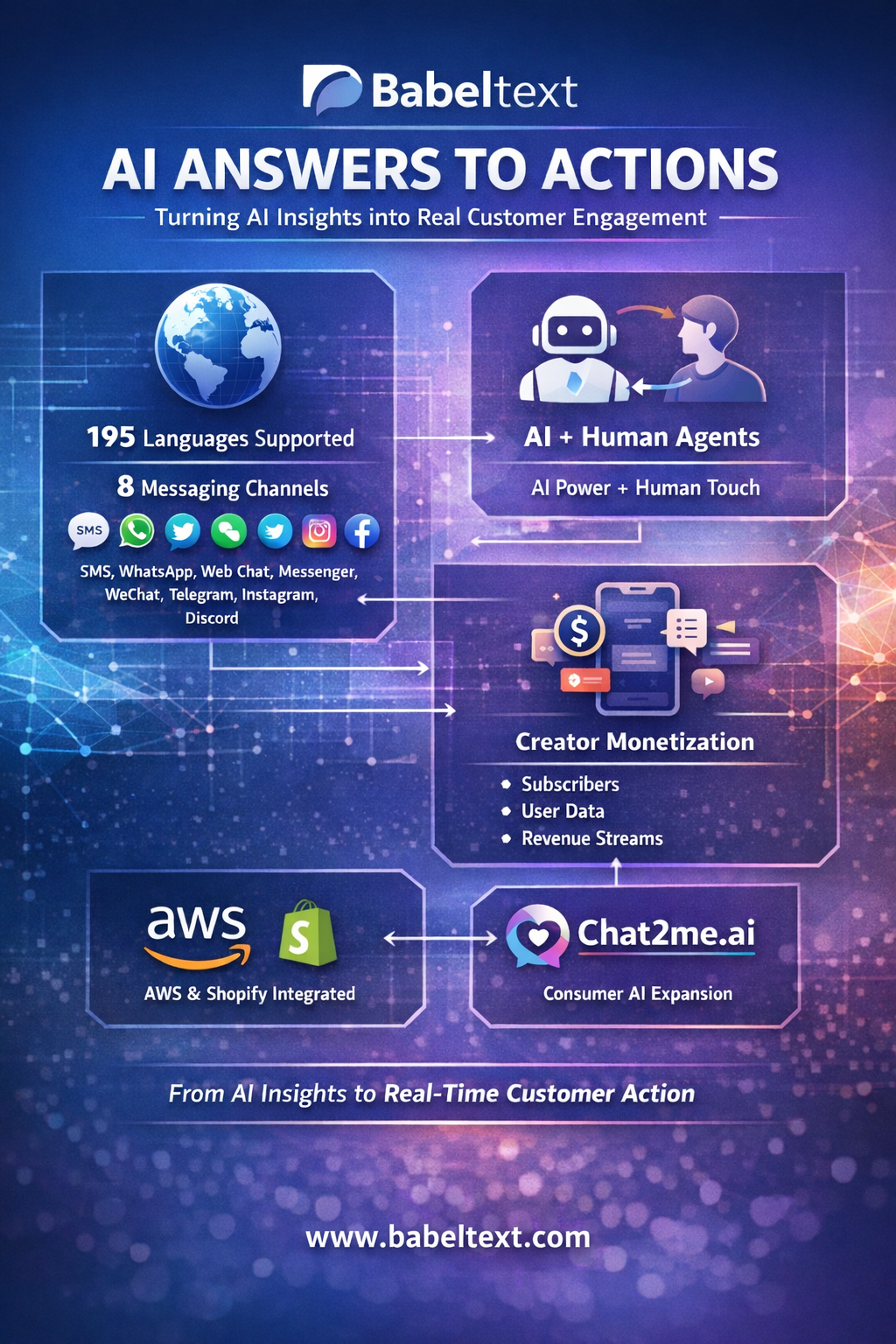
Babeltext has been designed specifically to address this evolution. Rather than treating SMS as a standalone utility, Babeltext positions SMS as a core component of a unified, multilingual engagement platform that converts messages into real-world actions
At the heart of Babeltext is a single, centralised interface that consolidates SMS alongside Web Chat, WhatsApp, Messenger, WeChat, Telegram, Instagram, and Discord. This enables organisations to manage all customer and citizen conversations in a single operational environment, dramatically reducing complexity, cost, and fragmentation. SMS becomes part of a broader engagement strategy, not an isolated channel.
195 Languages: Solving a Critical Market Gap
One of the most significant limitations of traditional A2P SMS platforms is language. As governments, enterprises, and global brands serve increasingly multicultural and international audiences, language exclusion has become both a service risk and a reputational risk.
Babeltext addresses this directly by supporting real-time engagement in 195 languages, allowing SMS conversations to be understood and responded to instantly, regardless of the sender’s or recipient’s language
This capability is particularly valuable in public sector services, healthcare, crisis support, tourism, and global commerce—sectors where clarity and accessibility are essential.
From Automation to “AI Answers to Actions”
While many A2P SMS providers are adding basic automation, Babeltext’s approach to AI is structurally different. Through native integration with OpenAI, Perplexity, and AWS Bedrock, Babeltext deploys AI agents that interpret intent, translate in real time, summarise conversations, route messages intelligently, and escalate seamlessly to human agents when required
This enables what Babeltext defines as “AI Answers to Actions.” AI does not merely generate responses; it drives outcomes—appointments booked, issues resolved, services accessed, or support delivered. Where sensitivity, regulation, or nuance is required, trained human agents remain part of the workflow, ensuring trust and accountability.
Embedded AI guardrails ensure conversations remain appropriate, compliant, and safe, supporting deployment across government, youth services, and regulated enterprise environments.
Commercial Advantage and Data Ownership
Babeltext also redefines the commercial value of SMS engagement. Its subscription-based, pay-per-message model—particularly in influencer and creator markets—captures high-value first-party data, including verified mobile numbers, language preferences, channel usage, and full conversation histories
This data becomes a strategic asset. For enterprises, it enables deeper insight into customer behaviour and intent. For influencers and brands, it provides measurable engagement and attribution far beyond traditional follower metrics, creating new monetisation and partnership opportunities.
Enterprise-Grade Scale and Trust
Built on AWS infrastructure and distributed via the AWS Marketplace, Babeltext meets the procurement, security, and governance standards required by enterprise and government buyers. Its global scalability allows organisations to expand SMS-led engagement internationally without re-engineering systems or adding vendors.
Conclusion
As the A2P SMS market continues its expansion toward 2035, the defining question is no longer how many messages can be delivered, but how effectively those messages drive engagement and action.
Babeltext represents the next generation of SMS, where messaging becomes multilingual, conversational, intelligent, and outcome-driven. In a market long dominated by infrastructure, Babeltext stands apart as a platform purpose-built for the future of engagement.